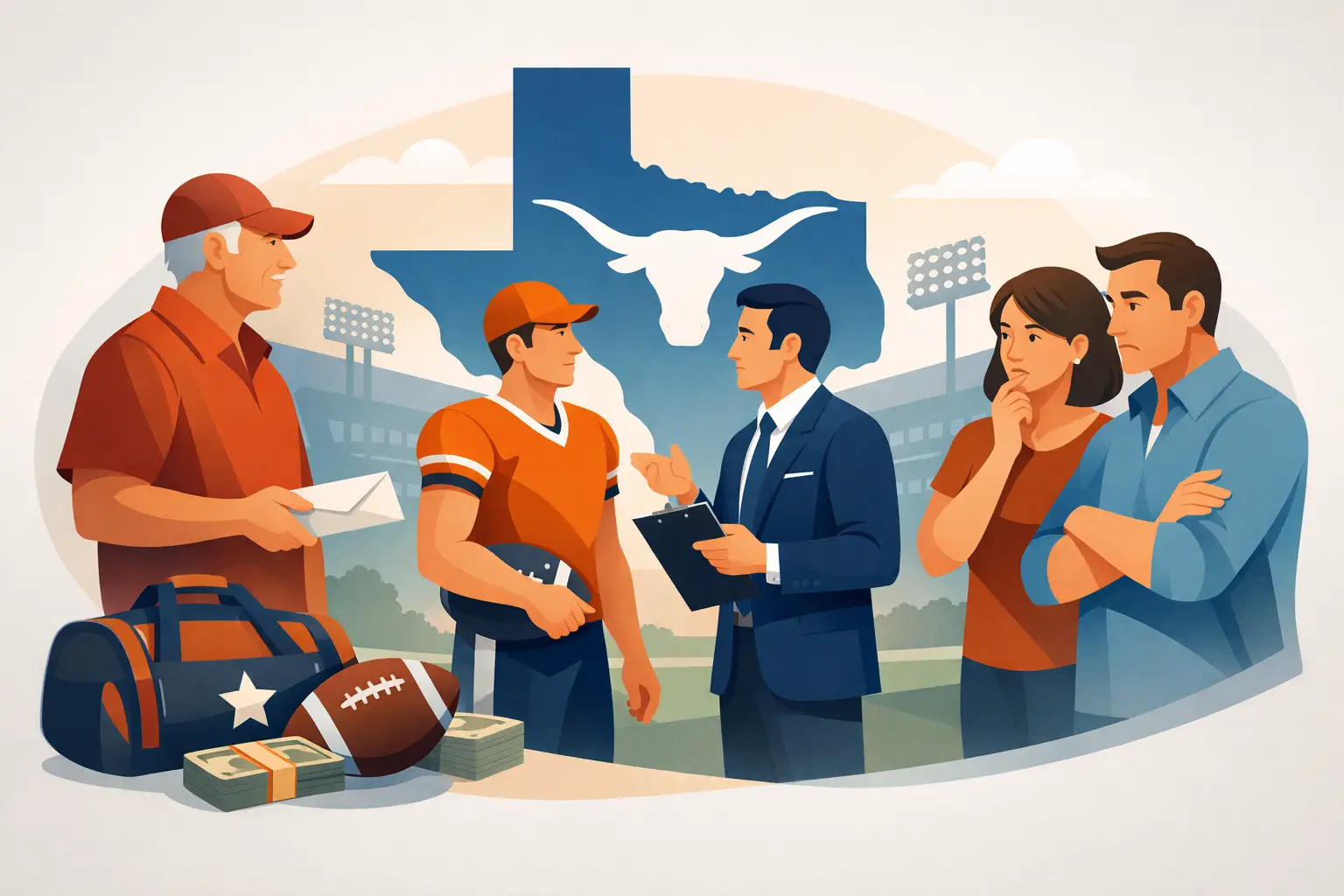
A direct message from a prominent donor can feel flattering. An invitation to meet a booster at a game can seem harmless. A promise that “there will be opportunities here” may sound like ordinary recruiting talk. But when parents ask, can boosters contact recruits, the safest answer is usually simple: not in a recruiting capacity.
That answer deserves context. College recruiting, NIL activity, booster involvement, and Texas high school rules do not always use the same vocabulary. Families should not have to sort out those distinctions while their child is being pressured to respond immediately. The practical rule is to slow down, preserve the communication, and involve the college’s compliance office before treating any booster outreach as normal.
Can Boosters Contact Recruits Under NCAA Rules?
At most colleges, a booster is known in NCAA terminology as a representative of athletics interests. That can include a major donor, a booster-club officer, a business owner who regularly supports a program, a collective supporter, or someone otherwise connected to a school’s athletic fundraising and recruiting ecosystem. The label is broader than many families realize.
Generally, boosters are not permitted to recruit prospective student-athletes on a school’s behalf. That means they should not call, text, direct message, email, meet with, or otherwise encourage a recruit or the recruit’s family to choose a particular college. The restriction is not avoided because the conversation happens off campus, through a personal account, at a club tournament, or after the student initiates contact.
A booster also should not make a recruiting pitch through a parent, coach, trainer, teammate, or other intermediary. “We would love to have you here,” “our donors take care of athletes,” and “tell your son to call the staff” may each raise concerns depending on the circumstances and the school’s rules.
The NCAA’s rules and interpretations can differ by division, sport, and factual situation. They also continue to evolve as NIL policy changes. That is why a family should not rely on a booster’s confidence that an interaction is permitted. The college compliance office is the appropriate source for a school-specific answer.
NIL Does Not Create a Free Pass for Booster Recruiting
NIL has made the booster question more complicated because some supporters may fund, advise, or participate in collectives and athlete marketing opportunities. Families may hear that a collective is “independent” and assume normal recruiting rules no longer apply. That assumption can create real risk.
NIL compensation must be tied to a legitimate use of an athlete’s name, image, or likeness. It should not be a disguised payment simply for enrolling at a school, signing with a team, transferring, or remaining on a roster. A booster cannot turn an impermissible recruiting inducement into a permissible arrangement by calling it an NIL deal.
The facts matter. A legitimate NIL opportunity generally has identifiable business or promotional value: a social-media campaign, an appearance, content creation, an endorsement, a camp appearance, or another defined service. There should be a real agreement, clear expectations, and compensation that makes sense for the work involved. A vague promise of future money if a student selects a particular school deserves careful scrutiny.
For a Texas high school athlete, the line deserves even more care. UIL rules and local district policies affect eligibility, school involvement, amateur status questions, and the use of school marks, facilities, uniforms, and personnel. A parent should never assume that a college-level NIL practice translates cleanly to a high school setting. The athlete may have a genuine opportunity, but the way it is structured and promoted still matters.
What Counts as “Contact” in a Booster Conversation?
Parents sometimes picture a formal phone call when they hear the word contact. In practice, the concern can begin much earlier. A like, follow, or public congratulatory comment is not automatically a violation. But repeated social-media engagement that turns into recruiting conversation can be different.
Warning signs include a booster asking where the athlete is leaning, offering to arrange a meeting with a coach, discussing anticipated NIL money, promising introductions to businesses, or asking the family to keep the conversation private. The same is true when a booster offers travel, lodging, event access, gifts, meals, or other benefits connected to the athlete’s college decision.
The issue is not whether the booster seems kind or whether the family asked for advice. The question is whether the contact is connected to recruiting or an inducement. A conversation that begins as casual praise can quickly become a compliance problem when it includes a pitch, an offer, or pressure to commit.
There are narrow situations where a booster and recruit may already know each other through a genuine, long-standing relationship that existed apart from athletics. A neighbor, family friend, or employer does not lose every ability to speak with a student simply because the student is a recruit. Still, that relationship does not permit the person to recruit for a college or make benefits available because of the student’s athletic ability. These situations are fact-specific and should be disclosed to compliance before assumptions are made.
A Parent’s Best Response to Booster Outreach
Parents do not need to accuse anyone or create conflict. They do need to protect their student from making a fast response that becomes difficult to explain later. A calm, professional approach works best.
First, save the messages. Screenshot texts, direct messages, emails, and any proposed terms. Make a brief note of when an in-person conversation occurred, who attended, and what was said. Accurate records are useful if the family later needs clarification.
Second, do not negotiate an NIL arrangement, accept a benefit, or agree to meet privately until the relevant school can review the situation. If the outreach appears connected to a college program, contact that program’s compliance office. If the student is still in high school, include the high school athletic director or another appropriate school official when UIL or district eligibility could be affected.
Third, use plain language when responding. A parent can say: “Thank you for reaching out. Because our student is being recruited, we need the college compliance office to confirm what contact and any proposed opportunity are permitted.” That response is respectful, does not burn a relationship, and places responsibility where it belongs.
Finally, be cautious with urgency. “This offer expires tonight,” “do not tell the coaching staff,” or “everyone does this” are not signs of a healthy opportunity. Legitimate organizations understand that families need time to review an agreement, seek guidance, and follow school procedures.
Questions Families Should Ask Before Any NIL Discussion
When a booster, collective, business, or third party raises NIL, parents should ask what the athlete is actually being asked to do and whether payment is connected in any way to enrollment or team participation. They should also ask who is funding the deal, whether the college knows about it, what disclosures are required, and whether the opportunity affects UIL or school-district rules.
The answers should be specific. “We will figure it out later” is not a business arrangement. Neither is a promise based only on an athlete’s decision to attend a particular school. Families should expect written terms that describe deliverables, payment timing, cancellation provisions, use of the athlete’s image, exclusivity, taxes, and who may approve the content.
For younger athletes, the most protective answer may be no. A middle school or early high school athlete does not need to become a brand manager because adults around the sport are talking about NIL. Development, academics, character, and a healthy recruiting process remain more valuable than a rushed arrangement.
The Bigger Lesson for Texas Families
Recruiting attention can make ordinary boundaries feel inconvenient. Families may worry that asking compliance questions will make them appear difficult or cost their child an opportunity. A well-run college program should see the opposite: a family that communicates carefully, follows rules, and protects its student is demonstrating maturity.
Boosters can play meaningful roles in college athletics, and legitimate NIL opportunities exist. But a booster’s enthusiasm is not compliance approval, and an NIL label is not a cure for recruiting inducements. When the conversation starts to sound like a promise in exchange for a decision, pause before responding.
The best next step is rarely the fastest one. Give your student the confidence to say, “We need to check the rules first.” That single sentence can protect eligibility, preserve options, and keep a recruiting decision centered on the right reasons.